Liquid Filling

Filling

If you’re evaluating in line filling machines, making a decision usually comes down to a few variables: Speed (number of containers per minute), fill volume per container, viscosity, particulates, sterility requirements, fill accuracy, product stability, product foaming and of course budget. The filler types below offer solutions based on those variables. Beverages, personal care, nutraceutical, chemicals each have unique considerations, so it is best to contact an expert to make sure the considerations are evaluated properly. Call 303-327-4704 or contact us.
Piston Fillers

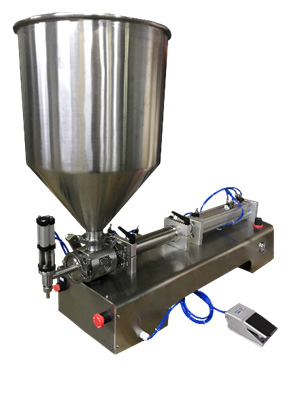
Piston fillers use a piston and cylinder to draw in and dispense a fixed volume of liquid. They can operate mechanically or pneumatically and are typically highly accurate and repeatable. Rotary valves can be used for products with particulates such as sauces.

O rings will be the main wear parts and their wear life will depend on the product being pumped. Single piston fillers are inexpensive and the most common choice for start-up operations. Multiple pistons can be mounted onto a common frame so multiple containers fill each cycle.

Advantages:

  • Excellent accuracy with higher viscosity, though there are limits.
  • Handles chunky or particulate products.
  • Easily adjusted fill volumes.
  • Multiple heads can be assembled for higher volume production.

Limitations:

  • Disassembly after each production run.
  • Single Piston
Single Piston Filler

Piston Filler Training Video

Multi Head Piston Filler

Multi Head Piston Filler

CBD Using Multi-Head Piston Filler

CBD Oil Filling Equipment

Gravity and Pressure Gravity Fillers aka. Time Based Fillers

Both of these fillers rely on gravity and pressure so the product to flows from the reservoir through tubes into the containers. They are typically set on a timer to control the volume in each container. Adjustments assures the same amount flows into each container.

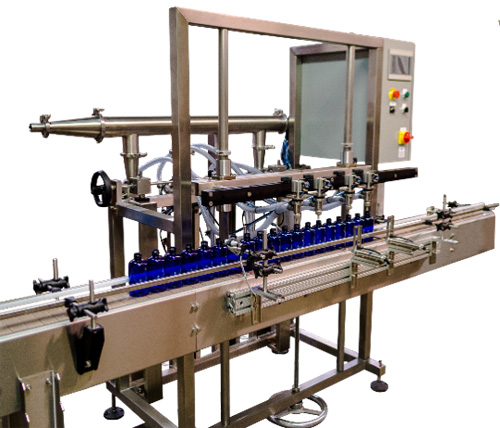
Gravity Fillers

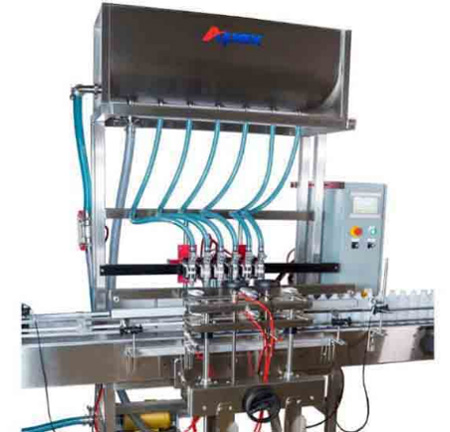
We have installed gravity fillers up to twelve bottles per cycle and they rely on gravity to move liquid from a reservoir into containers. The cycle speed will depend on viscosity and fill volume but expect 4-10 cycles per minute times the number of heads for total output. These are best for: thin, free-flowing liquids (water, juice).

Advantages:

  • Simple and low cost

Limitation:

  • Poor performance with viscous or foamy products
  • Require adjustments for different viscosities to maintain even fill levels
Gravity Filler

Pressure Gravity Fillers

Similar to the gravity filler except that it applies air pressure to the head space in the reservoir to assist flow of the liquid into containers. For products with a little more viscosity, the additional pressure increases the flow rate. Usually, 3-5 psi is all that is required.

Advantages:

  • Best for: low–medium viscosity liquids
  • Faster and more controlled than gravity
Pump Filler

Pump Fillers (Gear / Lobe / Rotary)

There are a variety of Pump Fillers. These can be used for filling and as a supply pump to fill a hopper/reservoir on the container filler. Contact us with your specific application.

Advantages:

  • Handles wide viscosity ranges
  • Higher flow rates
  • Flexible and scalable

Limitation:

  • Maintenance requirements
  • Higher upfront cost

Pump Filler

Peristaltic Fillers

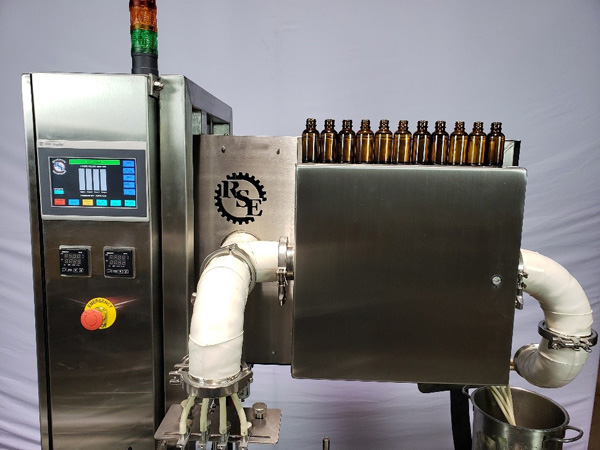
Rotating rollers compress flexible tubing, pushing liquid forward without the product contacting the pump components. These are often used for high-purity liquids (pharmaceuticals, biotech, cosmetics). They are very accurate and the change-over time is minimal since it only requires changing the tube for product changes.

Advantages:

  • No product contact with mechanical parts (only tubing)
  • Excellent for aseptic filling
  • Easy cleaning and changeover (just replace tubing)

Limitations:

  • Typically, lower throughput. High volume containers run slowly
  • Tubing wear requires periodic replacement
Peristaltic Fillers

Peristaltic Fillers

Overflow Fillers

Containers do not always have the same volume inside. This is particularly true of glass. Therefore, the same volume can appear as a different fill level in the container. To address this, overflow fillers fill to a consistent height in the containers. When the fill level reaches an exact height, the excess liquid is removed from the container. This allows products to be merchandized with the exact same fill level.

Advantages:

  • Use for clear containers where uniform appearance matters
  • Consistent fill height
  • Thin, free-flowing liquids (water, alcohol)
  • Simple and cost-effective

Limitations:

  • Waste/recirculation not ideal for some liquids
Overflow Fillers

Overflow Fillers

Capping and Retorque Equipment

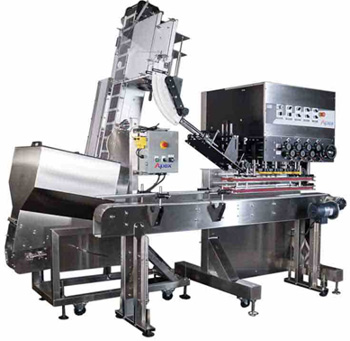
Inline Spindle Capping Machine

An inline spindle capping machine is an automatic cap applicator and tightener system where containers travel along a conveyor and pass through a cap applicator and sets of rotating wheels (“spindles”) that tighten caps. Loose caps are loaded into a cap elevator or bowl feeder. Either will deliver caps to the applicator and then spindle station where they are applied and tightened onto containers. Multiple spindle sets progressively tighten the cap to the desired torque with friction. Inspection systems can be added after capping. Depending on container sizes, 100+ containers per minute can be capped. The machines are continuous motion (no stopping required) and adjustable for different bottle and cap sizes. Spindle cappers are best suited for screw caps (plastic or metal) in industries like beverages, food, personal care, nutraceutical and chemicals

Advantages:

  • High throughput
  • Flexible and easy to adjust
  • Lower cost than some precision capping systems

Limitations:

  • Occasional cross threaded caps 0.5 to 4%. Depends on set up, container and caps used.
Inline Spindle Capping Machine

Video Capper Setup

Video Filling and Capping

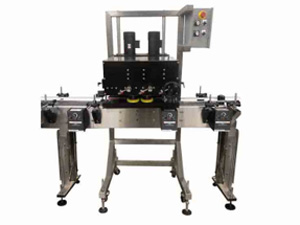
Spindle Retorque Machine

An inline spindle retorque machine is a secondary capping tightening system used after the initial capping process assure the correct the tightness (torque) is completed on the finished product. Many containers contain a membrane seal under the cap which ensures product integrity and safety. These seals are removed before the product is used. They are presented to the container in the production process as part of the cap when applied to the container. They are adhered to the container via energy from an induction sealer. This set often leaves the cap feeling loose even though the membrane seal is applied. As a result, these filling lines often have retorque units. They operate the same way as the spindle capper except they only contain the spindles to re tighten the cap, so it is snug when the consumer picks up the product.

Spindle Retorque Machine
Ready to get started with case packing?